Can You Name a Baby a Kpop Idols Name
| Korean name | |
| Hangul | 이름 / 성명 |
|---|---|
| Hanja | 이름 / 姓名 |
| Revised Romanization | ireum / seongmyeong |
| McCune–Reischauer | irŭm / sŏngmyŏng |
A Korean name consists of a family proper noun followed by a given name, as used past the Korean people in both South korea and North Korea. In the Korean language, ireum or seongmyeong usually refers to the family name (seong) and given name (ireum in a narrow sense) together.
Traditional Korean family unit names typically consist of merely one syllable. There is no centre name in the English sense. Many Koreans accept their given names fabricated of a generational proper name syllable and an individually distinct syllable, though this do is declining in the younger generations. The generational name syllable is shared by siblings in North Korea, and by all members of the aforementioned generation of an extended family unit in South korea. Married men and women proceed their full personal names, and children inherit the begetter's family name unless otherwise settled when registering the wedlock.
The family names are subdivided into bon-gwan (clans), i.due east. extended families which originate in the lineage system used in previous historical periods. Each association is identified by a specific place, and traces its origin to a common patrilineal ancestor.
Early on names based on the Korean language were recorded in the Iii Kingdoms menstruation (57 BCE – 668 CE), simply with the growing adoption of the Chinese writing system that was used as the script before the adoption of hangul in the 14th century, these were supplemented by Korean names that were written using Chinese characters (hanja). During periods of Mongol alliance, the ruling course supplemented their Korean names with Mongolian names when interacting with the Mongol Court and used Korean names in Korea and in other places.
Because of the many changes in Korean romanization practices over the years, modern Koreans, when using languages written in Latin script, romanize their names in various ways, most often approximating the pronunciation in English orthography when using their names exterior of Korea. Some keep the original order of names, while others contrary the names to match the usual Western blueprint.
According to the population and housing demography of 2000 conducted by the South Korean authorities, in that location are a full of 286 surnames and 4,179 clans.[ane]

Half of South Koreans carry the family unit name Kim, Lee, Park, or Choi
Kim, Gim, Ghim
Lee, Yi, Rhee, Yie
Park, Pak, Bahk
Choi, Choe
Jung, Jeong, Chung, Cheong
Family names [edit]
| Korean | Hanja | Revised | MR | Common spellings |
|---|---|---|---|---|
| 김 | 金 | Gim | Kim | Kim, Gim |
| 리 (N) 이 (S) | 李 | I | Ri (N) Yi (Southward) | Lee, Rhee, Yi |
| 박 | 朴 | Bak | Pak | Park, Pak, Bak |
| 최 | 崔 | Choe | Ch'oe | Choi, Choe, Chue |
| 정 | 鄭 | Jeong | Chŏng | Chung, Jeong, Cheong, Jung |
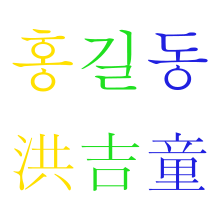
Both the top and bottom lines describe the Korean name Hong Gil-dong, which is a common anonymous name like John Doe. The top line is written as the hangul version (Korean characters), and the lesser as the hanja version (Chinese characters). In both instances the family name Hong is in yellow.
Fewer than 300 (approximately 280)[iii] Korean family names were in use in 2000, and the three most common (Kim, Lee, and Park) account for nearly half of the population. For various reasons, there is a growth in the number of Korean surnames.[3] [four] Each family name is divided into one or more than clans (bon-gwan), identifying the clan's city of origin. For example, the most populous association is Gimhae Kim; that is, the Kim clan from the city of Gimhae. Clans are further subdivided into various pa, or branches stemming from a more than recent mutual antecedent, so that a full identification of a person's family name would be clan-surname-co-operative. For instance, "Gyeongju Yissi" also romanized as "Gyeongju Leessi" (Gyeongju Lee clan, or Lee clan of Gyeongju) and "Yeonan-Yissi" (Lee clan of Yeonan) are, technically speaking, completely different surnames, fifty-fifty though both are, in most places, simply referred to as "Yi" or "Lee". This also ways people from the same association are considered to be of same blood, such that marriage of a man and a woman of same surname and bon-gwan is considered a strong taboo, regardless of how distant the actual lineages may exist, even to the present twenty-four hours.
Traditionally, Korean women keep their family names after their union, simply their children take the father'due south surname. In the premodern, patriarchal Korean society, people were extremely conscious of familial values and their ain family identities. Korean women keep their surnames subsequently wedlock based on traditional reasoning that information technology is inherited from their parents and ancestors, and cannot be changed. Co-ordinate to traditions, each association publishes a comprehensive genealogy (jokbo) every 30 years.[five]
Around a dozen ii-syllable surnames are used, all of which rank after the 100 well-nigh common surnames. The five most common family unit names, which together make upwards over one-half of the Korean population, are used by over 20 million people in Republic of korea.[2]
After the 2022 census, information technology was revealed that foreign-origin family names were condign more mutual in Due south Korea, due to naturalised citizens transcribing their surnames in hangul. Between 2000 and 2015, more than iv,800 new surnames were registered. During the census, a total of 5,582 distinct surnames were collected, 73% of which do not have corresponding hanja characters. It was too revealed that despite the surge in the number of surnames, the ratio of top 10 surnames had not changed. 44.vi% of South Koreans are still named Kim, Lee or Park, while the rest of the meridian 10 are made up of Choi, Jeong, Kang, Jo, Yoon, Jang and Lim.[6]
Given names [edit]
Traditionally, given names are partly adamant by generation names, a custom originating in Prc. One of the two characters in a given name is unique to the individual, while the other is shared past all people in a family generation. In both Due north and South korea, generational names are normally no longer shared by cousins, but are still commonly shared by brothers and sisters.[7] [8]
Given names are typically composed of hanja, or Chinese characters. In Due north Korea, the hanja are no longer used to write the names, but the meanings are even so understood; thus, for example, the syllable cheol (철, 鐵 ) is used in boys' names and means "iron".
| Tabular array of (Additional) Hanja for Personal Name Use | |
| Hangul | 인명용추가한자표 |
|---|---|
| Hanja | 人名用追加漢字表 |
| Revised Romanization | Inmyeongyong chuga hanjapyo |
| McCune–Reischauer | Inmyŏngyong ch'uga hanchap'yo |
In South korea, section 37 of the Family unit Registry Law requires that the hanja in personal names be taken from a restricted list.[9] Unapproved hanja must exist represented by hangul in the family registry. In March 1991, the Supreme Court of South Korea published the Tabular array of Hanja for Personal Proper name Use, which immune a total of 2,854 hanja in new South Korean given names (equally well every bit 61 alternative forms).[10] The listing was expanded in 1994, 1997, 2001, 2005, 2007, 2008, 2010, 2013 and 2015. Thus, viii,142 hanja are at present permitted in South Korean names (including the prepare of basic hanja), in addition to a small number of alternative forms.[11] The use of an official list is similar to Japan'south use of the jinmeiyō kanji (although the characters do non entirely coincide).
While the traditional practice is withal largely followed, since the late 1970s, some parents have given their children names that are native Korean words, usually of two syllables. Pop given names of this sort include Haneul (하늘; "Heaven" or "Sky"), Areum (아름; "Beauty"), Iseul (이슬; "Dew") and Seulgi (슬기; "Wisdom").[12] Between 2008 and 2015, the proportion of such names amidst South Korean newborns rose from 3.five% to seven.7%. The most pop such names in 2022 were Han-gyeol (한결; "Consistent, Unchanging") for boys and Sarang (사랑; "Love") for girls.[13] Despite this trend away from traditional exercise, people's names are still recorded in both hangul and hanja (if bachelor) on official documents, in family genealogies, and then on.
Originally, there was no legal limitation on the length of names in South korea. Every bit a effect, some people registered extremely long given names composed of native Korean words, such equally the 16-syllable Haneulbyeolnimguleumhaesnimbodasarangseuleouli (하늘별님구름햇님보다사랑스러우리; roughly, "More than beloved than the stars in the heaven and the sun in the clouds"). However, start in 1993, new regulations required that the given proper noun exist 5 syllables or shorter.[14]
Usage [edit]
Forms of address [edit]
The usage of names is governed by strict norms in traditional Korean club. It is generally considered rude to address people by their given names in Korean culture. This is specially the instance when dealing with adults or one'south elders.[15] It is acceptable to call someone past his or her given name if he or she is the same age equally the speaker. However, it is considered rude to utilise someone'due south given name if that person'south age is a year older than the speaker. This is often a source of pragmatic difficulty for learners of Korean as a strange language, and for Korean learners of Western languages.
A variety of replacements are used for the actual name of the person. It is acceptable amid adults of similar status to accost the other by their total name, with the suffix ssi (氏, 씨) added. However, information technology is inappropriate to accost someone by the surname alone, fifty-fifty with such a suffix.[16] Whenever the person has an official rank, it is typical to address him or her past the name of that rank (such as "Manager"), oftentimes with the honorific nim (님) added. In such cases, the full name of the person may be appended, although this tin can also imply the speaker is of higher status.[16]
Amid children and close friends, information technology is common to apply a person'southward birth name.
Traditional nicknames [edit]
Among the common people, who have suffered from high child mortality, children were often given an amyeong (babyhood name), to wish them long lives by avoiding observe from the messenger of expiry.[17] These sometimes-insulting nicknames are used sparingly for children today.[xviii]
After union, women usually lost their amyeong, and were called by a taekho, referring to their town of origin.[17]
In addition, teknonymy, or referring to parents by their children's names, is a common practice. Information technology is most commonly used in referring to a mother past the name of her eldest child, as in "Cheolsu's mom" (철수 엄마). However, it can be extended to either parent and whatsoever child, depending upon the context.[nineteen]
Gender [edit]
Korean given names' correlation to gender is circuitous, and past comparison to European languages less consistent.[20] Certain Sino-Korean syllables carry masculine connotations, others feminine, and others unisex. These connotations may vary depending on whether the character is used as the first or second character in the given name. A dollimja generational mark, once confined to male descendants but now sometimes used for women as well, may farther complicate gender identification. Native Korean given names show similar variation.
A further complexity in Korean text is that the atypical pronoun used to place individuals has no gender.[21] This means that automated translation ofttimes misidentifies or fails to identify individuals' gender in Korean text and thus presents stilted or incorrect English output. (Conversely, English source text is similarly missing information virtually social condition and age critical to smoothen Korean-linguistic communication rendering.)[21]
Children traditionally take their male parent's family unit name.[22] Under South Korean Ceremonious Law effective one January 2008, though, children may be legally given the last name of either parent or fifty-fifty that of a step-parent.[23]
History [edit]
The use of names has evolved over time. The showtime recording of Korean names appeared equally early as in the early Three Kingdoms period. The adoption of Chinese characters contributed to Korean names. A complex system, including courtesy names and pen names, as well as posthumous names and childhood names, arose out of Confucian tradition. The courtesy name system in detail arose from the Archetype of Rites, a core text of the Confucian canon.[24]
During the Three Kingdoms period, native given names were sometimes equanimous of three syllables like Misaheun (미사흔) and Sadaham (사다함), which were later transcribed into hanja (未斯欣, 斯多含). The utilize of family names was limited to kings in the kickoff, but gradually spread to aristocrats and eventually to most of the population.[25]
Some recorded family names are apparently native Korean words, such as toponyms. At that time, some characters of Korean names might have been read not by their Sino-Korean pronunciation, but by their native reading. For instance, the native Korean name of Yeon Gaesomun (연개소문; 淵蓋蘇文), the showtime Yard Prime Minister of Goguryeo, can linguistically be reconstructed as "Eol Kasum" (/*älkasum/).[26] Early Silla names are also believed to stand for One-time Korean vocabulary; for instance, Bak Hyeokgeose, the proper name of the founder of Silla, was pronounced something like "Bulgeonuri" (弗矩內), which can exist translated every bit "bright globe".[27]
In older traditions, if the proper name of a baby is not called by the third trimester, the responsibility of choosing the name fell to the oldest son of the family. Ofttimes, this was the preferred method as the proper name chosen was seen as good luck.
According to the chronicle Samguk Sagi, family names were bestowed by kings upon their supporters. For instance, in 33 CE, King Yuri gave the 6 headmen of Saro (later Silla) the names Lee (이), Bae (배), Choi (최), Jeong (정), Son (손) and Seol (설). However, this business relationship is non mostly credited past modern historians, who concur that Confucian-manner surnames as in a higher place were more likely to take come into full general employ in the fifth and subsequent centuries, as the Three Kingdoms increasingly adopted the Chinese model.[28]
Only a handful of figures from the Three Kingdoms flow are recorded as having borne a courtesy name, such as Seol Chong. The custom only became widespread in the Goryeo period, every bit Confucianism took concord among the literati.[29] In 1055, Goryeo established a new law limiting access to the ceremonious service examination to those with family names.[17]
For men of the aristocratic yangban class, a complex system of alternate names emerged by the Joseon period. On the other hand, commoners typically just had a showtime name.[17] Surnames were originally a privilege reserved for the yangban class, merely members of the centre and common classes of Joseon order frequently paid to learn a surname from a yangban and be included into a clan; this practice became rampant past the 18th century,[30] leading to a significant growth in the yangban class only conversely diluting and weakening its social potency.[31] For instance, in the region of Daegu, the yangban who had comprised 9.2% of Daegu's demographics in 1690 rose to 18.seven% in 1729, 37.5% in 1783, and 70.3% in 1858.[32] It was not until the Gabo Reform of 1894 that members of the outcast form were allowed to adopt a surname.[33] Co-ordinate to a census called the minjeokbu (民籍簿) completed in 1910, more than one-half of the Korean population did not have a surname at the time.[17]
For a brief flow afterward the Mongol invasion of Korea during the Goryeo dynasty, Korean kings and aristocrats had both Mongolian and Sino-Korean names. The scions of the ruling grade were sent to the Yuan court for schooling.[34] For example, King Gongmin had both the Mongolian proper name Bayan Temür (伯顏帖木兒) and the Sino-Korean proper noun Wang Gi (王祺) (later renamed Wang Jeon (王顓)).[35]
During the period of Japanese colonial rule of Korea (1910–1945), Koreans were forced to adopt Japanese-language names.[36] Even today, information technology is common for Korean nationals living in Nihon to use Japanese family names as well. Also known equally tsūshōmei ( 通称名 ) or tsūmei ( 通名 ), such an alternative name can exist registered as a legal alias and used in many official contexts including bank accounts and health insurance.
In 1939, as part of Governor-General Jiro Minami's policy of cultural absorption (同化政策; dōka seisaku), Ordinance No. 20 (commonly called the "Name Order", or Sōshi-kaimei (創氏改名) in Japanese) was issued, and became law in April 1940.[37] Although the Japanese Governor-Full general officially prohibited compulsion, low-level officials effectively forced Koreans to adopt Japanese-style family and given names. By 1944, nearly 84% of the population had registered Japanese family names.[37]
Sōshi (Japanese) means the creation of a Japanese family proper name (shi, Korean ssi), distinct from a Korean family name or seong (Japanese sei). Japanese family names stand for the families they vest to and can exist changed by marriage and other procedures, while Korean family names represent paternal linkages and are unchangeable. Japanese policy dictated that Koreans either could annals a completely new Japanese family proper name unrelated to their Korean surname, or take their Korean family proper name, in Japanese course, automatically become their Japanese name if no surname was submitted before the deadline.[38]
After the liberation of Korea from Japanese rule, the Name Restoration Lodge (조선 성명 복구령; 朝鮮姓名復舊令) was issued on Oct 23, 1946, past the United States military machine administration south of the 38th parallel north, enabling Koreans to restore their original Korean names if they wished.
Japanese conventions of creating given names, such as using "子" (Japanese ko and Korean ja) in feminine names, is seldom seen in present-solar day Korea, both North and South. In the North, a campaign to eradicate such Japanese-based names was launched in the 1970s.[7] In the South, and presumably in the North equally well, these names are regarded as old and unsophisticated.[39]
Romanization and pronunciation [edit]
In English-speaking nations, the three nearly common family unit names are oft written and pronounced as "Kim" (김), "Lee" (Southward) or "Rhee" (N) (이, 리), and "Park" (박).
The initial audio in "Kim" shares features with both the English 'yard' (in initial position, an aspirated voiceless velar finish) and "hard m" (an unaspirated voiced velar end). When pronounced initially, Kim starts with an unaspirated voiceless velar stop sound; it is voiceless like /yard/, but besides unaspirated like /ɡ/. As aspiration is a distinctive feature in Korean only voicing is not, "Gim" is more likely to be understood correctly. However, "Kim" is used every bit romanized name in both North and South Korea.[40]
The family name "Lee" is romanized as 리 (ri) in North korea and as 이 (i) in South Korea. In the former example, the initial sound is a liquid consonant. At that place is no distinction between the alveolar liquids /l/ and /r/, which is why "Lee" and "Rhee" are both common spellings. In Republic of korea, the pronunciation of the name is merely the English vowel audio for a "long due east", as in 'run across'. This pronunciation is also often spelled as "Yi"; the Northern pronunciation is commonly romanized "Ri".[41]
In Korean, the name that is unremarkably romanized equally "Park" actually has no 'r' audio. Its initial sound is an unaspirated voiced bilabial end, similar English 'b' at the beginning of words. The vowel is [a], similar to the 'a' in father and the 'a' in heart, so the name is also ofttimes transcribed "Pak, "Bak" and "Bahk."[42]
Many Korean names were romanized incorrectly from their bodily pronunciation. For instance, Kim, Lee and Park are pronounced closer to Gim, Yi and Bak in Korea. In order to correct this problem, Southward Korea's Ministry building of Culture, Sports and Tourism has developed the Revised Romanization of Korean to replace the older McCune–Reischauer system in the year 2000 and now the official spelling of these three names has been changed to Gim, I and Bak.
South korea's Ministry of Civilisation, Sports and Tourism is encouraging those who "newly" register their passports to follow the Revised Romanization of Korean if possible, but information technology is not mandatory and people are allowed to register their romanized name freely given that it is their starting time registration.[43]
English language Convention [edit]

Ban Ki-moon in Davos, Switzerland - the usual presentation of Korean names in English, as shown hither, is to put the family unit name kickoff (Ban is the family unit proper noun)
In English publications, including newspapers, Korean names are usually written in the original society, with the family name outset and the given name terminal. However, Koreans living and working in Western countries volition usually adopt the Western order, with the given name first and the family proper name last. The usual presentation of Korean names in English is similar to those of Chinese names and differs from those of Japanese names, which, in English publications, are usually written in a reversed order with the family proper noun last.[44]
See too [edit]
- Listing of Korean surnames
- List of Southward Korean surnames past prevalence
- Bon-gwan
- Korean clan names of foreign origin
- Article 809 of the Korean Civil Code
- Chinese name
- List of Korean given names
Notes [edit]
- ^ "2000 인구주택총조사 성씨 및 본관 집계결과". 통계청 (in Korean). Statistics Korea. Retrieved 20 Oct 2017. [ permanent dead link ]
- ^ a b South korea. National Statistical Office. Archived March 1, 2007, at the Wayback Machine The full population was 45,985,289. No comparable statistics are available from Democratic people's republic of korea. The elevation 22 surnames are charted, and a rough extrapolation for both Koreas has been calculated "Archived copy". Archived from the original on 2016-06-28. Retrieved 2006-08-22 .
{{cite spider web}}: CS1 maint: archived re-create as title (link). - ^ a b The Korean Drama & Movies Database, Everything you lot ever wanted to know near Korean surnames Archived March iv, 2016, at the Wayback Car
- ^ U.S. Library of Congress, Traditional Family unit Life. Archived Nov 3, 2016, at the Wayback Motorcar
- ^ Nahm, pg.33–34.
- ^ "Foreign-origin family names on ascension in Southward Korea". The Korea Herald. 2017-01-09. Retrieved 2017-01-ten .
- ^ a b NKChosun.com
- ^ Harkrader, Lisa (2004). South Korea. Enslow Pub. Inc. p. 24. ISBN978-0-7660-5181-2.
Many South Korean families today are relatively small, and may not include sons, so South Korean parents have begun to choose names for their sons that do not follow the traditional requirements of generation names.
- ^ Republic of korea, Family Annals Law
- ^ National Academy of the Korean Language (1991) Archived March 19, 2016, at the Wayback Machine
- ^ '인명용(人名用)' 한자 5761→8142자로 대폭 확대. Chosun Ilbo (in Korean). 2014-ten-20. Retrieved 2017-08-23 .
- ^ Jeon, Su-tae (2009-x-19). "사람 이름 짓기" [Making a name]. The Hankyoreh. Archived from the original on 2014-04-16. Retrieved 2012-12-21 .
- ^ 신생아 인기 이름 '민준·서연'…드라마 영향? [Popular names for newborns: Min-jun and Seo-yeon ... the issue of TV dramas?]. Seoul Broadcasting System. nine May 2016. Retrieved six December 2017.
신생아에게 한글 이름을 지어주는 경우는 2008년 전체의 3.5%에서 지난해에는 두 배가 넘는 7.7%에 달했습니다. 가장 많이 사용된 한글 이름은 남자는 '한결', 여자는 '사랑'이었습니다.
- ^ "한국에서 가장 긴 이름은?" [What'due south the longest name in Korea?]. Hankyoreh. 18 January 2008. Retrieved 6 August 2015.
- ^ The Northern Forum (2006), p.29.
- ^ a b Ri 2005, p.182.
- ^ a b c d due east 이름. 다음 백과 (Daum Encyclopedia) (in Korean). Retrieved 22 October 2017.
- ^ Naver Encyclopedia, Nickname (별명, 別名).
- ^ Hwang (1991), p.9.
- ^ Enquire A Korean, Information technology's Not Only That They All Wait The Same Archived October 13, 2016, at the Wayback Automobile, 4 August 2008
- ^ a b Hee-Geun Yoon, Seng-Bae Park, Yong-Jin Han, Sang-Jo Lee, "Determining Gender of Korean Names with Context," alpit, pp.121-126, 2008 International Conference on Avant-garde Language Processing and Spider web Data Engineering science, 2008
- ^ Nahm, Andrew C. (1988). Korea: Tradition and Transformation — A History of the Korean People. Elizabeth, NJ: Hollym International.
- ^ Park, Chung-a, Children Can Adopt Mothers Surname Archived June nine, 2016, at the Wayback Motorcar, The Korean Times, 3 June 2007
- ^ Lee, Hong-jik (1983), p.1134.
- ^ Practice (1999), sec. 2.
- ^ Chang, Sekyung, Phonetic and phonological report on the different transcriptions of the Same personal names, Seoul: Dongguk University (1990). (in Korean)
- ^ Practice (1999), sec. 3.
- ^ Do (1999).
- ^ Naver Encyclopedia, 자 [字]. Seol Chong'south courtesy name, Chongji (총지) is reported in the Samguk Sagi, Yeoljeon 6, "Seol Chong".
- ^ "Why and so many Koreans are called Kim". The Economist. 8 September 2014. Retrieved 23 October 2017.
- ^ "(three) 사회 구조의 변동". 우리역사넷 (in Korean). National Plant of Korean History. Retrieved 23 October 2017.
- ^ "three) 양반 신분의 동향". 우리역사넷 (in Korean). National Constitute of Korean History. Retrieved 23 October 2017.
- ^ 한국족보박물관 개관…'족보 문화'의 메카 대전을 가다. 헤럴드경제 (in Korean). Herald Corporation. 26 May 2010. Retrieved 23 October 2017.
- ^ Lee (1984), p.156.
- ^ Lee, Hong-jik (1983), p.117.
- ^ U.South. Library of Congress, Korea Under Japanese Rule. Archived Nov 3, 2016, at the Wayback Machine
- ^ a b Nahm (1996), p.223. Encounter also Empas, "창씨개명".
- ^ Empas, "창씨개명".
- ^ "How Korean Names Work 2022 | Order Of First Names, Kim Surname, And More - Korea Truly". koreatruly.com. 2021-11-08. Retrieved 2021-12-21 .
{{cite web}}: CS1 maint: url-condition (link) - ^ Yonhap (2004), 484–536 and 793–800, passim.
- ^ Yonhap (2004), pp. 561–608 and 807–810, passim.
- ^ Yonhap (2004), pp.438–457.
- ^ "로마자성명 표기 변경 허용 요건". Ministry of Foreign Affairs. 2007. Retrieved 2019-05-21 .
- ^ Power, John. "Japanese names." (Archive) The Indexer. June 2008. Volume 26, Result ii, p. C4-two-C4-eight (seven pages). ISSN 0019-4131. Accession number 502948569. Available on EBSCOHost.
Further reading [edit]
| | This section needs to be updated. (May 2019) |

- Hwang, Shin Ja J. (1991). "Terms of Address In Korean and American Cultures" (PDF). Intercultural Communication Studies I:ii. trinity.edu. Archived from the original (PDF) on 2006-08-23. Retrieved 2008-09-11 .
- Lee, Ki-baek (1984). A new history of Korea . Rev. ed., Tr. past Edward Westward. Wagner & Edward J. Shultz. Seoul: Ilchokak. ISBN978-89-337-0204-eight.
- Nahm, Andrew C. (1988). Korea: Tradition and Transformation — A History of the Korean People. Elizabeth, NJ: Hollym International. ISBN978-0-930878-56-6.
- The Northern Forum (2006). "Protocol Manual". Anchorage, AK: northernforum.org. Retrieved 2006-08-23 .
- U.Southward. Library of Congress (1990). "Korea Under Japanese Rule". In Andrea Matles Savada & William Shaw (ed.). South Korea: A Land Study. GPO for the Library of Congress. Retrieved 2006-08-10 .
- U.Due south. Library of Congress (1990). "Traditional Family Life". In Andrea Matles Savada and William Shaw (ed.). South korea: A Country Study. GPO for the Library of Congress. Retrieved 2006-08-10 .
- Yonhap (2004). Korea Annual 2004. 41st almanac ed. Seoul: Yonhap News Agency. ISBN978-89-7433-070-5.
- Do, Su-hui (도수희) (1999). "Formation and Evolution of Korean Names (한국 성명의 생성 발달, Hanguk seongmyeong-ui saengseong baldal)" (PDF) (in Korean). New Korean Life (새국어생활). Retrieved 2018-05-28 .
- Empas Encyclopedia (n.d.). "Changssi Gaemyeong (창씨개명, 創氏改名)" (in Korean). empas.com. Retrieved 2006-08-23 .
- Lee, Hong-jik (이홍직), ed. (1983). "Ja, Courtesy Name (자)". Encyclopedia of Korean history (새國史事典, Sae guksa sajeon) (in Korean). Seoul: Kyohaksa. pp. 117, 1134. ISBN978-89-09-00506-vii.
- National Academy of the Korean Linguistic communication (1991). "News from the National University of Korean Language (국립 국어 연구원 소식)" (in Korean). korean.become.kr. Retrieved 2006-08-23 .
- National Institute of the Korean Language (국립 국어 연구원) (June 1991). "National Institute of the Korean Language news (Gungnip gugeo yeonguwon saesosik, 국어 국립 연구원 새소식)". New Korean Life (in Korean). korean.go.kr. Retrieved 2006-08-11 . [ expressionless link ]
- Naver Encyclopedia (n.d.). "Courtesy proper name (자, 字)" (in Korean). naver.com. Retrieved 2006-08-22 .
- Naver Encyclopedia (n.d.). "Nickname (별명, 別名)" (in Korean). naver.com. Retrieved 2006-08-22 .
- NKChosun (2000-11-19). "Name cosmos/'ja' disappearing from female names (이름짓기/ 여성 이름 '자'字 사라져)" (in Korean). nk.chosun.com. Retrieved 2006-08-13 .
- South korea (north.d.). "Family Register Constabulary 양계혈통 관련법률" (in Korean). root.re.kr. Archived from the original on 2007-02-11. Retrieved 2006-08-23 .
- South korea (n.d.). "National Statistical Function" (in Korean). kosis.nso.get.kr. Archived from the original on 2006-09-07. Retrieved 2006-08-23 .
- Ri, Ui-practise (리의도) (2005). Proper Procedures for Korean Usage (올바른 우리말 사용법, Olbareun urimal sayongbeop) (in Korean). Seoul: Yedam. ISBN978-89-5913-118-1.
External links [edit]
- Korean surnames at Wiktionary
- Table of in 2001 added Hanja for Personal Proper noun Use
- Choosing between Korean Hanja and Hangul Names
- Family Register Law, Act 6438, 호적법, 법률6438호, partially revised October 24, 2005. (in Korean)
- Examples of Koreans who used Japanese names: by Saga Women's Junior College (in Japanese)
Source: https://en.wikipedia.org/wiki/Korean_name
0 Response to "Can You Name a Baby a Kpop Idols Name"
Post a Comment